
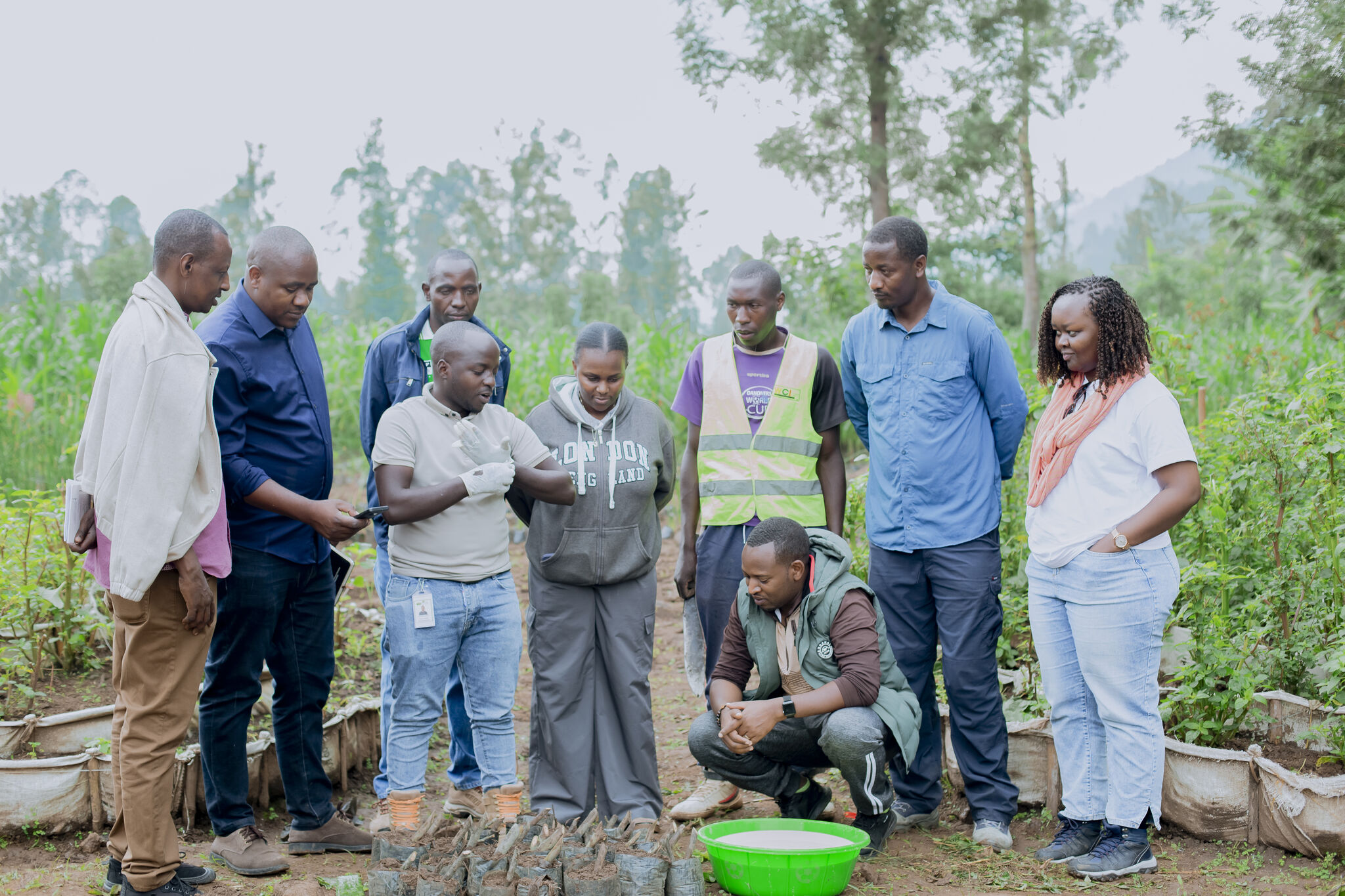
Some of the most transformative ideas begin with a conversation. For BIOCOOR , that conversation took place during the Restore Local Peer-to-Peer Learning Workshop in Nyabihu District- Rwanda, in December 2025. Amid discussions on restoration and
conservation, participants shared practical approaches that help communities engage with nature in new and meaningful ways. Wildlife Conservation Initiative shared how sports had become a powerful tool for bringing communities together, creating awareness, and inspiring collective action for conservation. The lesson was simple yet profound: restoration is not only about growing trees. It is also about growing connections between people. Rather than leaving the workshop with notes
and ideas that might never be applied, BIOCOOR returned home with a question that would spark a new initiative:
“How can we use our own culture and native/local knowledge to inspire the next
generation of conservation champions?”

[Photo: Restoration champions participating in the Restore Local Peer-to-Peer Learning Workshop in Nyabihu District, where the idea for WIRENGUTAMBWIYE was inspired.]
The workshop ended, but the inspiration endured. Back home, BIOCOOR began exploring how to connect young people with the wisdom of their elders and the rich environmental knowledge embedded in local traditions. The result was WIRENGUTAMBWIYE (which can translate to “Do not go before you teach me”)- a community initiative proving that the path to restoration can begin with stories, culture, and the passing of knowledge from one generation to the next.
Turning Inspiration into Innovation
Instead of replicating the sports-based model exactly, BIOCOOR adapted the concept to fit its local context. The organization recognized that communities in Gihombo Sector of Nyamasheke District in Rwanda- possess a wealth of traditional environmental knowledge that is at risk of being lost as generations change. Elders hold valuable insights about native tree species, biodiversity, and cultural practices that have supported sustainable natural resource management for decades.
WIRENGUTAMBWIYE was born as a platform to bridge that knowledge gap.
The initiative combines cultural heritage, conservation education, and intergenerational dialogue. Its core objective is to create a space where elders and young people can learn from one another while strengthening community ownership of land restoration efforts. Beginning in July 2026, the initiative will bring together participants from neighbouring villages through friendly competitions and debates focused on environmental stewardship.Elders will share native/local knowledge about forests, native species, and traditional environmental practices, while young people will engage through questions, discussions, and knowledge-sharing activities.
“Our goal is not only to restore landscapes, but also to restore the connection between generations and the knowledge that helps communities protect nature,” said Irene Duhuzukuli, Project Manager at BIOCOOR.
Beyond Events: Building a Culture of Stewardship
For BIOCOOR, WIRENGUTAMBWIYE is more than a community event. It is proof that peer learning can lead to real-world innovation. What began as an idea shared during a workshop evolved into a locally owned solution rooted in Rwanda’s cultural traditions and community strengths. By adapting a concept rather than copying it, BIOCOOR demonstrated how restoration organizations can learn from
each other while creating approaches tailored to their own realities.
Link: https://www.youtube.com/watch?v=XIG20qH2UJs [Embed BIOCOOR Video ]
The impact of peer learning is already visible in BIOCOOR’s broader restoration work. Between April and June 2026, the organization trained five women’s groups and university interns on practical tree management techniques, including mulching, pruning, watering, and pest and disease management. Through these sessions, 32 participants—26 women and 6 men—gained hands-on skills they have committed to sharing within their communities.
“When one person learns and shares that knowledge with others, restoration becomes a community effort rather than an individual responsibility,” Irene Duhuzukuli, Project Manager at BIOCOOR.
A Ripple Effect for Restoration
As WIRENGUTAMBWIYE takes shape, BIOCOOR hopes the initiative will strengthen community participation in restoration, preserve traditional ecological knowledge, and encourage young people to become environmental stewards. The organization also expects the program to support conservation of native species and strengthen efforts to protect ecosystems surrounding Nyungwe National Park. The story of WIRENGUTAMBWIYE shows the true power of peer learning. Sometimes, the most valuable outcome of a workshop is not a report or a presentation; it is a new idea. An idea that travels from one organization to another, evolves to fit a local context, and ultimately inspires action on the ground. For BIOCOOR, a conversation in Nyabihu District became a movement in Gihombo sector of Nyamasheke District- Rwamda. And that movement is helping ensure that knowledge, culture, and conservation continue to grow together for generations to come.
Learn More:
- Learn more about BIOCOOR Work here :www.biocoor.org.rw
- Learn more about Restore Local Initiative here : https://restorelocal.org/
- Discover more stories of Restoration Champions here : https://www.youtube.com/@RestoreLocal